My wife and I toured Wuhan in early October 2019. Wuhan, on the Yangtze River, is often compared to Chicago (transport hub – rail and river) and Detroit (industrial hub).

Beyond its modern facade, Wuhan has beautiful and historical sights that are real jawdroppers, such as the Hubei Provincial Museum containing the tomb of Marquis Yi of Zeng, who, despite living in turbulent period of war around 500 b.c. (2500 years ago), left astonishing artifacts which could only be those of an affluent and cultured man:
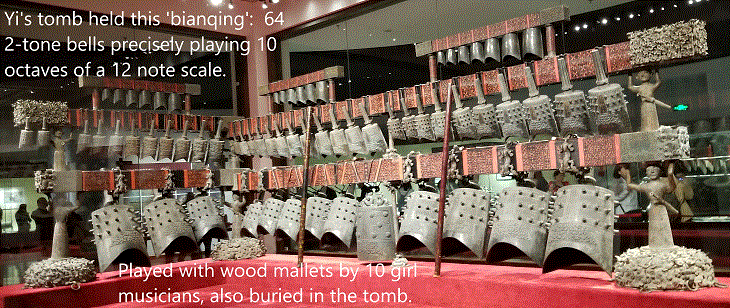
The bianqing was among 125 musical instruments and 1000s of ornate drinkware, kitchenware and tools found in the tomb. The 12 note scale was exported by Arab traders to Europe, from there it traveled worldwide via Imperialism.
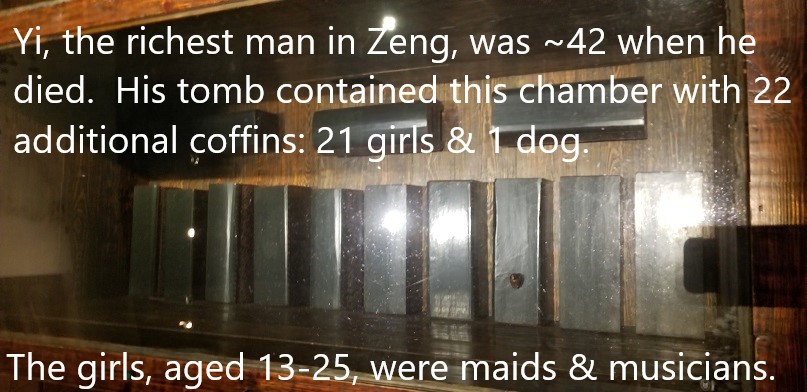
The tomb’s dark side is horrifying: All these treasures were buried, as was the custom, solely for Yi’s benefit in his afterlife, and his was but one of 23 coffins…
Elsewhere in Wuhan, we passed an old street vendor in ancient costume selling weapons, tools and illegal animal parts out of an open case (ready for quick getaway):
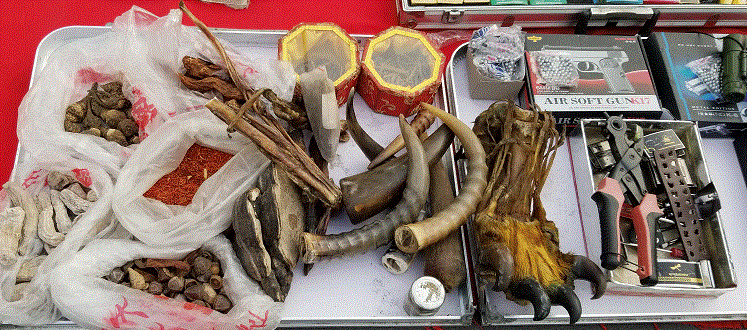
I had to hurriedly snap this picture as my wife was frantically pulling me away, fearing I could catch some bug just by being close. The pic says a lot about the extremes of traditional Chinese medicine, where buyers and sellers hold beliefs that can seem very strange to westerners.
For example, Thom Hartmann reported he saw a wild animal market in Taipei, Taiwan where men could buy a few drops of freshly squeezed Cobra venom and drink it mixed with vodka in a shot glass. This was believed to boost male vigor for a trip to the red light district next door.
- For those who couldn’t afford venom, blood dripping from a freshly cut snake could be substituted, but results were considered less reliable.
- This market has been shut down for years; but an illegal trade in wild animals persists throughout China and parts of Asia.
Traditional Chinese medicine always had its outliers as well as its well-regarded mainstream. The same is true with Chinese cuisine. Popular and healthful foods can be just an alley away from very odd entrees. Consider real Cantonese food as found in Guangzhou, Hong Kong and Shenzen: endless wonderful dishes but also, if you search for them, snake and insect dishes (snake tastes like chicken; insects are actually good for us).
In the rarest of cases, the fringes of ancient belief have proved deadly to the modern world: in 2002, followers of traditional Chinese medicine (perhaps neurotic cure-seekers) ate racoon dogs who were later discovered to have dined on bats infected with the SARS virus. SARS killed 774, mostly in the Cantonese region, in 2003.
After SARS, some wild animal sales were outlawed throughout China. But its possible that in a Wuhan market in early December 2019, laws were ignored by a vendor who sold & a buyer who bought some creature containing the new coronavirus, now known as COVID-19 (environmental scientists, however, say the source of the virus is more likely to have been unearthed by the expansion of Wuhan into previously rural areas. Similarly, the “Spanish” Flu of 1918 was probably due to the expansion of farming into a wild region of Kansas in the USA).
This market in Wuhan, now closed, is located 1/2 km (a few blocks) from Hankou station, one of Wuhan’s 3 giant new rail terminals where 200 mph trains load and unload 100,000 cross-country travelers daily. The virus has legs.
China’s government learned the hard way, from SARS and other tragedies, that its best to come clean with accurate numbers of fatalities and infections. So, in early 2020, I leaned toward accepting the numbers they released after they understood the scope of the disease (see “Notes”, below). (Update, early 2023: the Chinese government has, since early 2020, or all along, grossly under-reported their number of cases of the new coronavirus, now known as Covid2).
But they still make big mistakes: on January 3, the Governor of Hubei (Wuhan’s province) announced on TV that they were prepared for the virus.
- In response, doctors from Wuhan’s top hospitals hurriedly organized and went on TV begging for urgent donations, saying they had only a 5 day supply of face masks, hazmat suits and safety goggles. Sure enough, they ran out.
I asked my Chinese wife, will this new catastrophe, with its world-wide implications (illness; death; global commerce downturn & making China look bad), finally eliminate the market for wild animals?
She replied, “No way”. Her Chinese friends & relatives would agree. Craving for wild animal-based food & medicine will further decline but persist deeper underground.
Ancient beliefs die hard.
Notes
- China has an authoritarian government which could say whatever it wants, but learned through experience that honesty can make good policy. During the Cultural Revolution (1966-1976), 10 years the regime’s obfuscation caused national self-destruction. The lies believed by Red Guards tormented the country and destroyed many lives, including their own. The masses of Chinese gradually realized they were hurting themselves by carrying out self-destructive policies. Thus exposed, these falsehoods were discarded 44 years ago (after the trial of the “Gang of Four”), but by then every mainland Chinese distrusted the government. This led the Chinese to believe:
- Everything from modern China is bad, and
- Everything from other countries, especially the developed nations, is good.
This attitude persisted until the early 1990s, after years of growth. Today, thanks to economic expansion that has reached virtually everyone nationwide, Chinese have become very proud of modern China.
-
- Thus, to remain in power, Chinese leaders view truthfulness as a useful tool in the right circumstance.
- If they failed to be honest at the start of the SARS outbreak, the resultant criticism probably convinced some of them to be frank about future health crises. (Update, early 2023: Unfortunately, the Chinese government has, since early 2020, or all along, grossly under-reported their number of cases of the new coronavirus, now known as Covid2).
- Thus, to remain in power, Chinese leaders view truthfulness as a useful tool in the right circumstance.
- The talking heads on TV who imply China is lying about the numbers have the facts wrong. They say, ‘Wuhan has 15 million people, so they must have ~49,000 hospital beds. How could they have run out of hospital beds when there were only 1000-2000 cases?’
- Wuhan may have 15 million people within its city limits or metro area (I’ve seen 11 and 19 million, respectively), but it only has 10 or 11 million people in its contiguous urban area. So the proper number of hospital beds would only be roughly 33,000.
- Wuhan has expanded from maybe 3 million in 1980 to 11 million today, mostly since 2005. Located 850km (530 miles) from the sea, Wuhan is nowhere near as developed as the coastal cities, from Guangzhou to Tianjin, because China’s rapid development started on the coast before slowly moving inland. So in its current state, Wuhan is still severely lagging in health, intra-city transport and other services, including hospital beds.

 Tax the Rich, Pay the Rest